Resistant pathogens know no boundaries. That is why successfully combating them requires a coordinated and cross-sectoral approach. Four federal offices have been pursuing this One Health principle for a long time as part of the Strategy on Antibiotic Resistance Switzerland (StAR): the Federal Office of Public Health (FOPH), the Federal Food Safety and Veterinary Office (FSVO), the Federal Office for Agriculture (FOAG) and the Federal Office for the Environment (FOEN). With the StAR One Health Action Plan 2024 – 2027, the Federal Council is now intensifying its cross-sectoral activities once again.
Please note that not all content is available in English. To view all content, please visit the German, French or Italian version of our website.
Strategy on Antibiotic Resistance Switzerland (StAR)
Together with the international community, Switzerland must prevent the development of new resistant organisms and limit their transmission and spread. With these aims in mind, the Swiss Strategy on Antibiotic Resistance (StAR) specifies eight strategic action areas and objectives. StAR was formally approved by the Federal Council on 18 November 2015.
A good and comprehensive set of data creates the foundation which allows measures to be implemented in a targeted manner.
Develop and operate a comprehensive monitoring system: The system for monitoring antibiotic resistance and antibiotic consumption will be designed on a cross-sector and interdisciplinary basis. Any existing gaps in monitoring activities will be closed.
Develop and expand the network of reference laboratories for investigating antibiotic resistance and ensure quality assurance in all laboratories: A network will be established on the basis of the existing designated reference laboratories, in order to ensure the coordination and standardisation of laboratory investigations into antibiotic resistance.
Draw up and implement national guidelines on the standardised and targeted investigation of antibiotic resistance: National guidelines for the attention of the laboratories show which pathogens have to be tested for which type of resistance. These will be updated regularly and applied consistently.
Preventive measures promote the health of humans and animals in such a way that the use of antibiotics, and thus the development of resistance, can be reduced.
Develop and implement systems for monitoring, preventing and combating healthcare-associated infections: The consistent implementation of infection control and hygiene concepts will be promoted. Structural and organisational measures to prevent the spread of pathogens will be assessed and implemented.
Apply laboratory investigations with a strong practical emphasis in a targeted manner: Rapid laboratory investigations with a strong practical emphasis will be used in a targeted manner; rapid laboratory procedures will prevent inappropriate use of antibiotics in an outpatient setting.
Support vaccination campaigns aimed at particular target groups and diseases: Vaccinations which can contribute to reducing antibiotic consumption by preventing viral and bacterial infections will be promoted to specific target groups and individuals at risk of specific diseases.
Encourage improved animal husbandry processes, especially with regard to management, conditions under which animals are kept, and biosecurity: Typical errors and problems will be defined for particular animal species and production types, and attention drawn to remedial measures.
Identify and promote preventive measures to improve animal health: Preventive measures aimed at improving animal health will be taken before the use of antibiotics becomes necessary.
Optimise and promote the coordination and provision of advice to livestock farmers and support for farms: Systematic and continuous herd management in order to improve animal health and the provision of advice to livestock farmers will be promoted.
Reduce the volume of antibiotics, resistance genes and resistant bacteria entering the environment from research and production facilities: Affected companies, institutions and competent cantonal authorities will be made aware of the issue of resistance. In addition, the competent cantonal enforcement authorities and the national bodies responsible for assessing action will examine the suitability of and compliance with measures.
Antibiotics must be used appropriately to prevent the development of resistance.
Develop guidelines on the prescribing, dispensing and use of antibiotics and ensure their implementation: Responsible use of antibiotics will be encouraged by the elaboration and nation-wide application of uniform guidelines based on the current state of knowledge.
Restrict the prescribing, dispensing and use of antibiotics: Criteria for the prescribing, dispensing and use of antibiotics will be drawn up and consistently implemented. These relate in particular to antibiotics recently placed on the market as well as to antibiotics whose use is severely limited as part of a reserve antibiotics concept.
Facilitate access to expertise: Access to specific expertise and advice will be provided as required for specialists and for people affected by antibiotic resistance. Develop methods to deal with above-average use of antibiotics: Systems for a gradual process will be developed that will enable persistently high prescribers, dispensers or consumers of antibiotics to reduce the frequency of use.
Develop measures for above-average antibiotic use Systems for a step-by-step approach are being developed to enable farms with consistently high antibiotic prescriptions, dispensing or consumption to reduce the frequency of use.
When resistant organisms develop, these must be rapidly identified and their transmission and spread minimised. Resistant organisms must be rapidly identified and prevented from spreading. In human medicine, the task is to reduce the risk of introduction when patients are admitted to a hospital or nursing home – e.g. through preliminary examinations. In veterinary medicine, the main focus is to limit the spread of resistant pathogens between herds.
Prevent the entry of resistance into healthcare facilities and animal herds and its subsequent spread: Organism- and resistance-specific measures will be taken to prevent the introduction and spread of antibiotic resistance, and the efficacy of these measures will be assessed.
Devise and implement guidelines on targeted outbreak control: Targeted outbreak control processes will be devised for all relevant resistant organisms and implemented nationwide in all areas of healthcare.
Assess measures to reduce the spread of antibiotic resistance throughout the food chain: Measures aimed at minimising the spread of antibiotic-resistant bacteria throughout the plant and animal food chains will be assessed.
Reduce antibiotic resistance through the implementation of measures aimed at eliminating substance traces in waste water purification plants: Work will be done to clarify the extent to which existing measures aimed at eliminating antibiotics from waste water are also suitable for eliminating antibiotic-resistant organisms.
Interdisciplinary research and development focusing on the creation, transmission, spread and combating of resistant bacteria is being intensified.
Create an interdisciplinary platform for research into antibiotic resistance and define key research areas: A platform will be created that will give an up-to-date overview of ongoing research projects and allow key research areas to be defined.
Create basic principles concerning the entry of antibiotics into farmyard manure, soil and water and their persistence and activity: A feasibility study will be conducted to establish the basic principles for the long-term monitoring of antibiotics and resistance in farmyard manure, soil and water.
Promote new diagnostic methods: Research into new, cost-effective diagnostic methods for distinguishing between bacterial and viral infections and for the rapid detection of antibiotic resistance will be promoted.
Determine the significance of the cross-border movement of people, animals and goods to the resistance situation in Switzerland: The extent to which resistance is imported and exported will be investigated, for example through medical services abroad, tourism, animals treated with antibiotics and food contaminated with resistant organisms.
Cross-sector cooperation will be actively promoted and improved to successfully combat problems.
Create a cross-sector coordination body to implement the strategy: A cross-sector coordination body will ensure the coordinated cross-sector implementation of the antibiotic resistance strategy.
Set up a consultative expert body on antibiotic resistance and antibiotic consumption: A body will be set up to advise the Federal Council and the relevant federal offices on the implementation of the strategy.
Strengthen the involvement of learned societies, animal health services and other experts and stakeholders: The role of existing learned societies, research groups, animal health services and expert groups will be strengthened and supported. They will be involved in the production of guidelines and play a key part in the creation of networks and exchange of information.
Strengthen links with other countries with regard to strategic approaches and research: Experience from other national strategies will be continuously assessed and taken on board. Bilateral, international and multinational cooperation will be enhanced.
Set up and intensify support for developing countries: Support for developing and emerging countries in the area of antibiotic resistance will be enhanced, or set up where it does not yet exist
Knowledge of antibiotic resistance will be improved among experts and general public so that more responsible decisions are taken and resistance levels fall.
Inform the general public about the issue of antibiotic resistance and ways in which it can be prevented: More information will be provided to the general public about the development of antibiotic resistance, where antibiotics should and should not be used, and ways in which resistance can be prevented.
Raise awareness among stakeholders affected: Information will be tailored to specific target groups, and the specific requirements and needs of individual stakeholders will be taken into account.
Enhance the basic and further training of doctors, veterinarians and animal owners: Training plans will be devised for professions affected in order to increase understanding of antibiotic resistance, diagnosis, reventive measures and appropriate use of antibiotics.
The correct general conditions must be put in place to ensure that antibiotics remain effective in future. Suitable measures, e.g. at the political and legislative level, are designed to support the development of new antibiotics and their proper use. An analysis will also be conducted as to which incentives within animal husbandry lead to improved animal health and decreased use of antibiotics.
Identify and modify market mechanisms and incentive systems: Key points where incentive systems help avoid the use of antibiotics or support responsible use of antibiotics will be identified.
Improve the general conditions for public health studies on antibiotic resistance: Better general conditions will be created for research affecting the health of the entire population.
Improve the availability of first-choice antibiotics and encourage the development of new antibiotics: Efforts will be made to improve the availability of first-choice antibiotics on the Swiss market. This includes assessment of licensing conditions.
Strengthen consistent and harmonised enforcement: More effective enforcement instruments will be created. Inspections, assessments of deviations and enforcement measures will be harmonised.
Assess the introduction of targeted programmes for appropriate use of antibiotics: Consideration will be given to whether comprehensive programmes can be established in hospitals, veterinary clinics, care facilities and veterinary and medical practices to promote the appropriate prescribing, dispensing and use of antibiotics.
StAR One Health Action Plan 2024 – 2027
Various actions have been initiated and pursued since the Swiss Strategy on Antibiotic Resistance (StAR) was adopted in 2016. They have been successful, too: the consumption of antibiotics in Switzerland has been reduced, and the growth of such resistance has been stabilised for now. The global problem of antimicrobial resistance (AMR) continues to grow, however, and makes AMR one of the most urgent challenges faced by the healthcare systems of the 21st Century. For Switzerland it is crucial that StAR continues to be pursued with both vigour and precision, and with due and full regard to all the latest findings in the field.
To these ends, the Federal Council has resolved to comprehensively strengthen the country’s pursuit of StAR through a range of binding, innovative and sustainable measures which have all been incorporated into the StAR 2024-2027 One Health Action Plan.
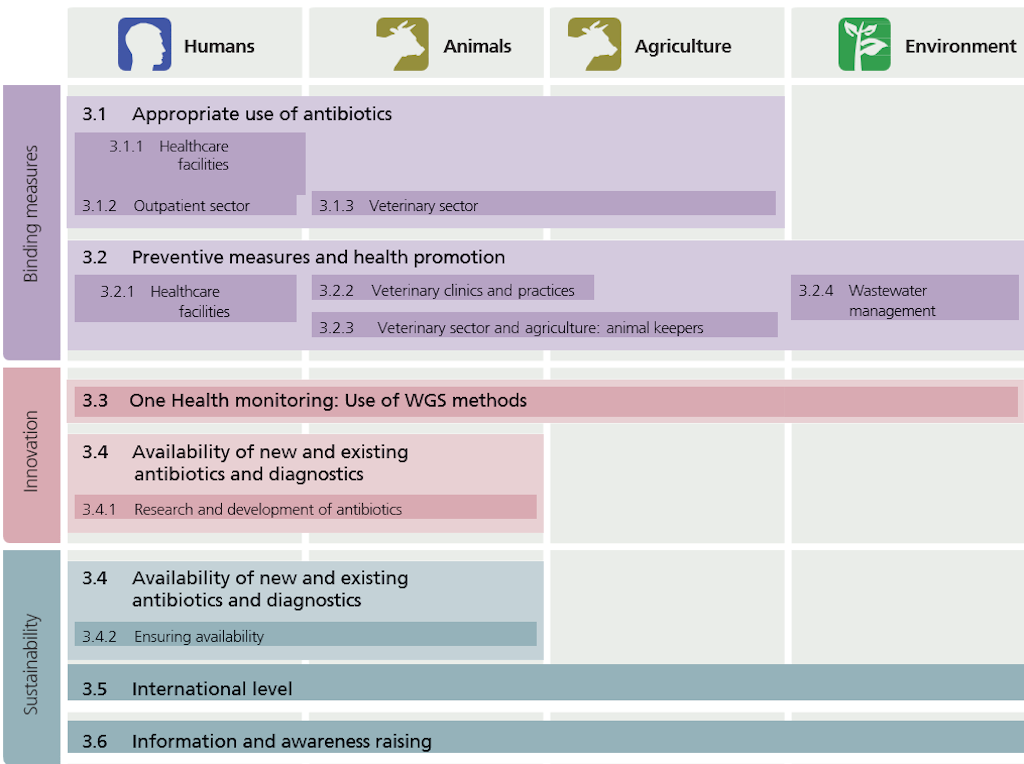
More binding measures: The tools already developed (e.g. treatment guidelines) are to be more widely publicised and their adoption promoted, with the goal of ensuring routine application. This will be supported by the expansion of stewardship programmes in hospitals, practices and veterinary clinics; the development and expansion of antibiotic use benchmarks for veterinarians, animal keepers and physicians; and programmes for infection prevention and control in healthcare facilities and veterinary clinics and practices.
Innovation: Increasing use is to be made of new scientific knowledge and technologies. For example, One Health cross-sectoral resistance monitoring via systematic collection of sequence data is to be further developed, contributing to an improved understanding of resistance transmission pathways. New incentive-based approaches will be assessed to improve the availability of antibiotics.
Sustainability: As antimicrobial resistance is an ongoing challenge, structures and processes for addressing it need to be assured over the long term. This will include the establishment of legal foundations.
Six main action areas
The One Health Action plan for StAR focuses on six main action areas and defines specific national goals with annual milestones for the planned activities.
Overview of main action areas in the Action Plan
The One-Health Principle
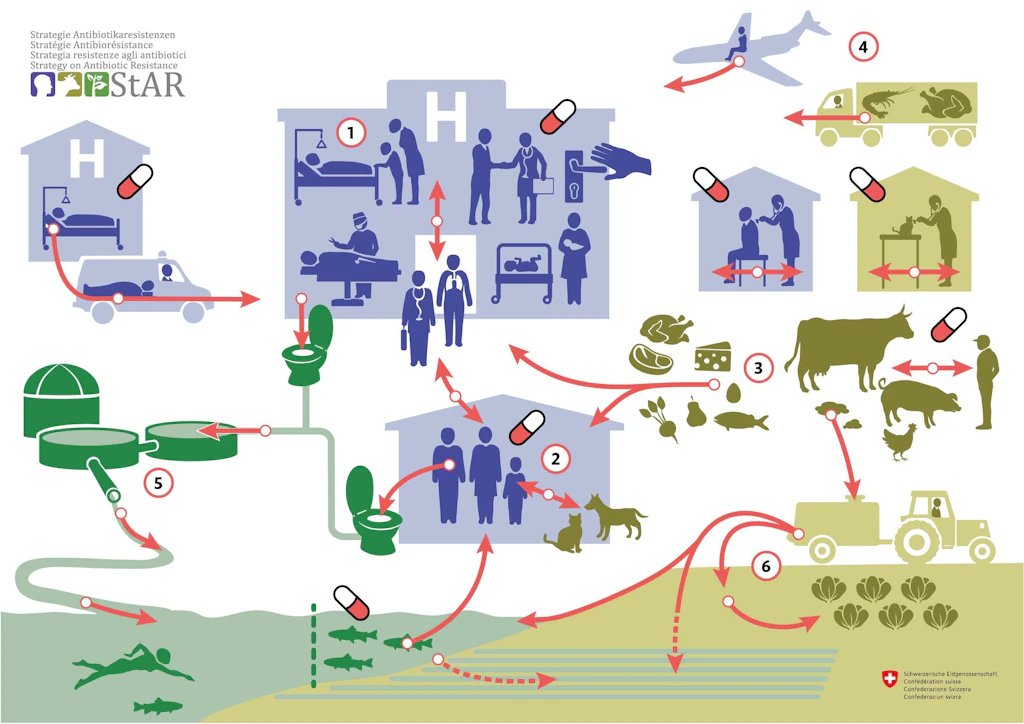
Resistance that bacteria can develop against antibiotics is a challenge. This challenge is being met jointly by various offices in Switzerland according to the One-Health principle. This is because antibiotic resistance has an impact in all areas: humans, animals and the environment.
-- 1 -- In healthcare settings – such as hospitals, medical practices, nursing homes, veterinary practices and veterinary clinics – resistant bacteria can be transmitted through direct contact. This can occur between patients, animals, visitors and staff. Contaminated surfaces and medical devices can also play a role. -- 2 -- Resistant bacteria can be transmitted between humans, animals and the environment. -- 3 -- Food can contain resistant bacteria – for example meat, dairy products, eggs, fish, seafood, vegetables and fruit. People can take up resistant bacteria through such foods. In certain cases, this can lead to foodborne infections. -- 4 -- Global travel and international trade can contribute to the spread of resistant bacteria. -- 5 -- Modern wastewater treatment plants remove a large proportion of resistant bacteria and antibiotics from wastewater. However, small quantities may still enter rivers, lakes or groundwater. -- 6 -- Spreading animal manure, such as slurry, on fields can also spread resistant bacteria. These bacteria can end up on plants, in groundwater, rivers or lakes.