
Availability of new antibacterial drugs in Switzerland: How do we compare with other countries?
10.07.2024 - New antibacterial drugs can save lives. Between 2010 and 2020, in the US, Canada, Europe and Japan, a total of 18 new antibacterial drugs were first approved and launched in at least one country. An analysis shows, however, that – even in high-income countries, including Switzerland – many of these new substances are launched with a time lag or not at all.
In severe bacterial infections, antibiotics and other antibacterial drugs can save lives. The global rise in the evolution of antibiotic-resistant pathogens is a cause for concern. In addition to the promotion of appropriate use and other measures, experts advocate the development of new antibacterial drugs.
A study by Outterson et. al. (2021) identified 18 new antibacterial drugs which, between 2010 and 2020, were first approved either in the US, Canada, Europe or Japan and placed on the market in at least one country. The study concludes, however, that even in high-income countries many of these new substances are either launched with a considerable time lag or not commercially launched at all. As the study provides no information on Switzerland, we researched the data on authorisation and market entry for the 18 substances in Switzerland and compared the situation with that in the other countries. For this purpose, we used Swissmedic’s “Extended list of authorised medicinal products” (as of 31.01.2024) and also obtained market entry data for all authorised antibacterial drugs from the individual authorisation holders.
International comparison of availability (2010 - 2020)
The analysis of this data shows that, between 2010 and 2020, 6 of the 18 antibacterial drugs studied were authorised and launched in Switzerland. In 2020, in the international comparison, Switzerland was thus level with Romania and Greece at the lower end of the mid-ranking countries (cf. brown bar in Figure 1). Lying behind Switzerland in this comparison were Denmark, Croatia, Japan and Canada.
One of the drugs, tedizolid (trade name Sivextro®), was in fact launched in Switzerland in 2016 but was subsequently withdrawn from the market in August 2020; according to Swissmedic, the authorisation holder chose not to renew the authorisation of this product. In response to our written enquiry, the company explained that alternative treatment options were available both within the same class (oxazolidinones) and in other classes of antibiotics. Thus, at the end of 2020, 5 of the 18 new drugs were commercially available in Switzerland.
The red line in Figure 1 shows the median number of days elapsing between first approval of a drug abroad – generally in the US – and commercial launch in a given country. In Switzerland, the median launch lag was 967 days (2 years and 8 months). This is similar to the lags observed for the neighbouring countries France and Italy.
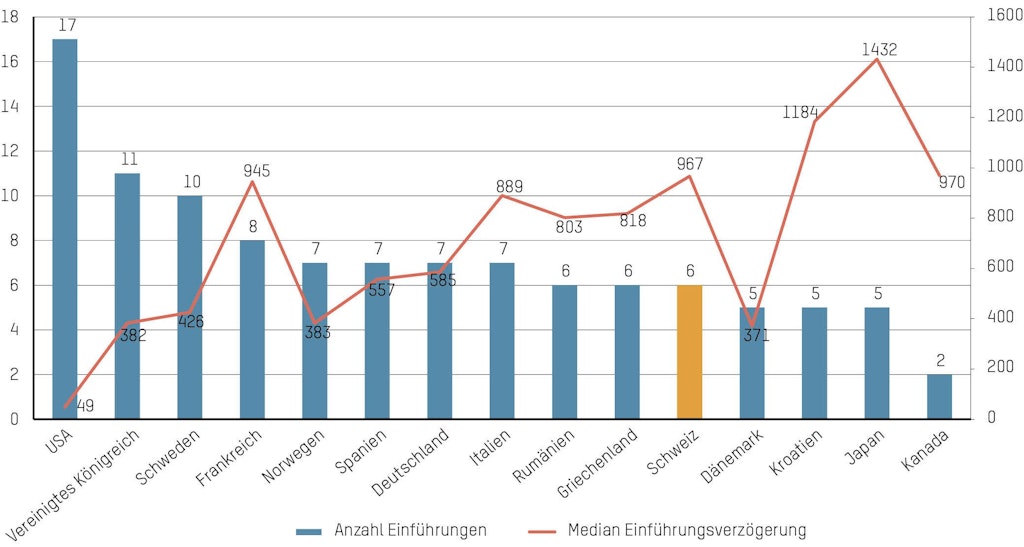
The international comparison shows that only in three countries – i.e. the US, the UK and Sweden – were the majority of the 18 new antibacterial drugs available during the study period. These three countries are among those which already employ incentive systems to promote the development and introduction of new antibiotics. In the remaining countries, including Switzerland, less than half of the new drugs were authorised and launched in the period under review.
Current availability of new antibacterial drugs in Switzerland (2023)
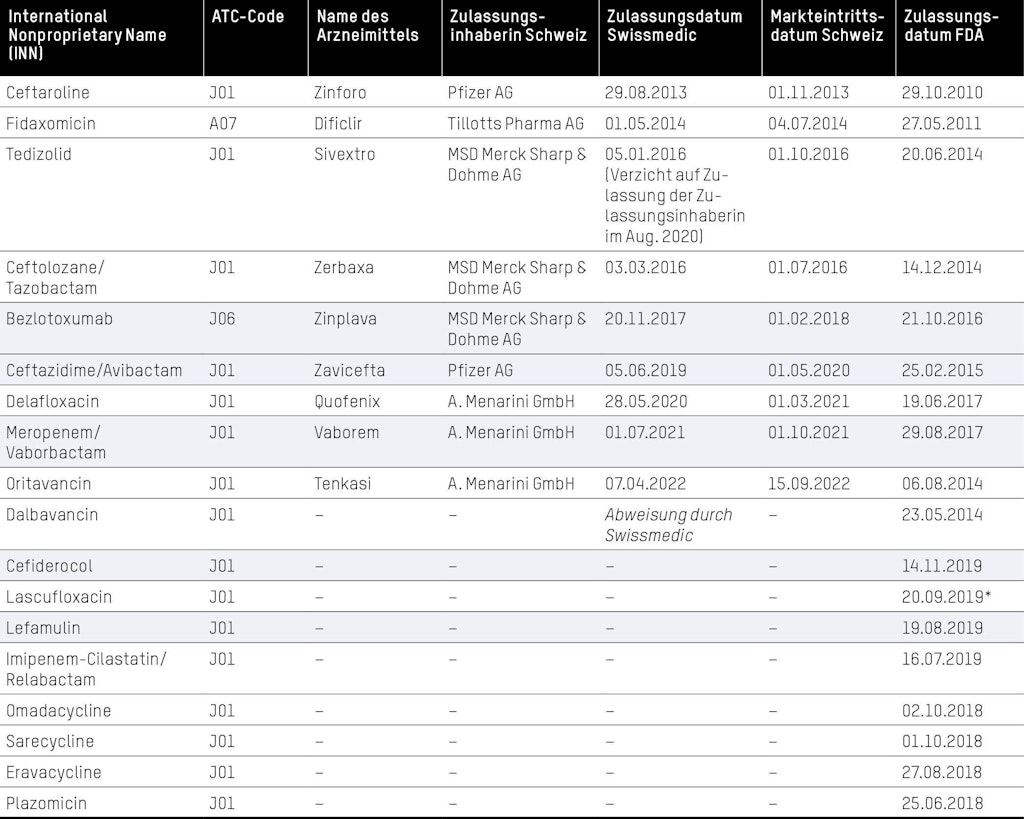
The above comparison relates to the period 2010–2020. Since then, there have been additional authorisations and launches in Switzerland (Table 1). Three years later, as of the end of December 2023, 8 of the 18 new drugs are authorised and commercially available in Switzerland.
Of the 18 new antibacterial drugs, 5 (i.e. bezlotoxumab, ceftazidime/avibactam, meropenem/vaborbactam, cefiderocol and lefamulin) have been designated as “innovative” or “possibly innovative” by the World Health Organization (WHO) or as “novel” by the Pew Charitable Trusts. In Table 1, these innovative new drugs are highlighted in blue. As of the end of December 2023, three of these products are authorised and commercially available in Switzerland.
Assessment of launch lags
For all the antibacterial drugs authorised by Swissmedic in the period 2010–2023, the median time lag between first approval abroad and launch in Switzerland is 3 years and 1 month (1,134 days). This time lag can be broken down roughly as follows (median values are given in all cases):
- Around 13 months elapse between the first approval abroad and the submission of an application for authorisation to Swissmedic.
- According to Swissmedic, the authorisation process (Swissmedic time plus company time) takes around 20 months.
- Around 4 months elapse between authorisation by Swissmedic and commercial launch in Switzerland.
Discussion
Between 2010 and 2020, in the US, Canada, Europe and Japan, a total of 18 new antibacterial drugs were approved for the first time and commercially launched. Of these 18 new drugs, 6 were authorised and launched in Switzerland. As of the end of December 2023, 8 of these 18 drugs are authorised and commercially available in Switzerland. How can the limited availability of new antibacterial drugs in Switzerland and in many other high‑income countries be explained? In their article, Outterson et al. (2021) suggest that, in the face of low expected sales and profitability, companies may decide to delay commercialisation or forgo it altogether in certain markets. Swissmedic confirms that drug manufacturers often fail to submit an application in Switzerland. Companies’ expected returns are not only affected by low price levels for antibiotics. Measures designed to reduce antibiotic resistance may also have unwanted effects on launch decisions. In the 2023 WHO AWaRe (Access, Watch, Reserve) classification, 13 of the 18 new drugs are listed in the “Reserve” category. Since reserve group antibiotics are to be used as little as possible, sales volumes are severely restricted.
At first glance, the total of 18 newly approved antibacterial drugs within a decade may appear to be high. However, only some of these drugs are effective against the priority drug-resistant pathogens identified by the WHO. Accordingly, the global pipeline of antibacterial drugs in clinical development is described by the WHO as “insufficient”. Every two years, the WHO publishes its Model List of Essential Medicines (EML , indicating those products which should be permanently available for the treatment of priority conditions in all healthcare systems. Of the 18 new drugs studied, 6 are included in the latest EML (2023), 3 of which are commercially available in Switzerland.
While Swiss hospitals may obtain drugs not commercially available in Switzerland from other countries with “comparable control of human medicinal products”, this practice – adopted in isolated cases – involves certain risks: the financial risk of having to discard expensive unused medicines is borne by the hospitals. In addition, timely provision of supplies in Switzerland cannot be guaranteed, especially in the event of international shortages.
It should be noted here that, in Switzerland, efforts are being pursued at various levels to improve the availability of antibiotics and other medicinal products. Thus, the federal authorities – in collaboration with stakeholders from industry, research, service providers, associations and cantons – are currently developing concrete proposals for implementation of the 2022 FOPH report entitled “Disruptions of Supplies of Medicinal Products for Human Use in Switzerland”. In addition, the multidisciplinary Round Table on Antibiotics is examining the suitability of new incentive models (“pull incentives”) for antibiotics in Switzerland. Here, support is being provided by the Strategy on Antibiotic Resistance (StAR), which is also including the topic of antibiotic availability in its new “One Health Action Plan 2024–2027”, to be adopted later this year. As part of the ongoing revision of the Epidemics Act, it is proposed that the necessary legal foundations should be established for such incentive models.