
Detecting new forms of antibiotic resistance
02/2023 - Multidrug-resistant pathogens pose an increasing risk to public health. To contain the spread of these types of bacteria, it is important to detect them early on. In Switzerland, this is done by the national reference laboratory for early detection and surveillance of new forms of antibiotic resistance (NARA).

Every year antibiotic-resistant bacteria cause over a million deaths worldwide. They are spreading constantly and often go unnoticed. The proper use of antibiotics slows down the generation of new resistance, and the development of innovative antibiotics helps control it. It is also important that pathogens be detected as early as possible to prevent them from spreading.
Up to 70 samples a month
Every month, the national reference laboratory for early detection and surveillance of new forms of antibiotic resistance (NARA) receives 60 to 70 samples of multidrug-resistant bacteria from all over Switzerland. After confirming the type of bacteria, the NARA deploys the latest molecular and biochemical analysis techniques to investigate the sensitivity of each sample to antibiotics.
New forms of resistance are emerging
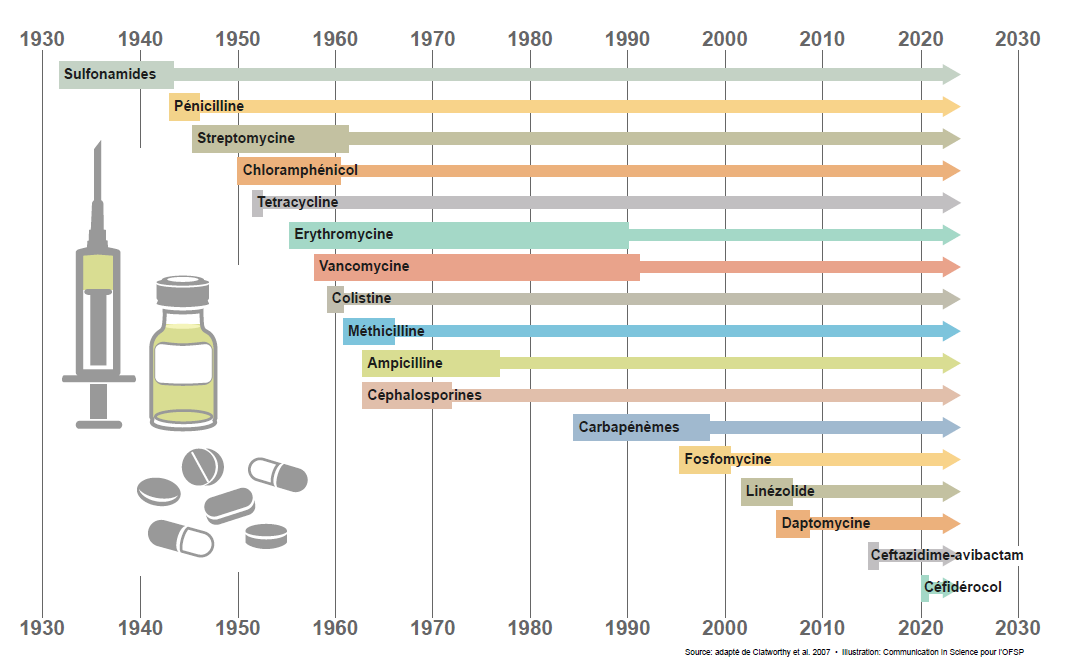
Globally, the most common pathogenic bacteria are increasingly resistant to one or more antibiotics. Antimicrobial-resistant bacteria have existed since the introduction of the first antibiotics. From the market launch of a new active agent until a resistant strain is detected it takes five years on average, although in recent years this period has often been shorter (see Figure). Of great concern is the development of resistance in enterobacteria such as those present in the human gut (e.g. E. coli), whose strains are increasingly multidrug-resistant, in other words resistant to several antibiotics.
Around a decade ago, the scientific community was primarily concerned about the increase in resistance to antibiotics from the penicillin family. To treat such resistant infections, a new class of antibiotics was used, called carbapenems. But the bacteria developed resistance to this class of antibiotics too.
In Switzerland, there has been an increase in carbapenemase-producing E.coli. This raises fears that these could gradually become endemic. A similar trend has been observed in France and Germany. However, this development is progressing at a moderate pace, as E. coli spreads relatively poorly in hospitals and typically cannot trigger outbreaks there.
Early detection is the basis for action
In over 50% of cases, carbapenem-resistant enterobacteria appear to have been acquired during stays abroad. This estimate was confirmed by the observed decline in case numbers in 2020 and 2021 when international travel was heavily restricted. What is particularly concerning is that an increasing number of imported strains of Acinetobacter baumannii are being detected that are resistant to virtually all antibiotics.
Only through early detection can multidrug-resistant strains of bacteria be controlled by ensuring that the affected patients are quickly placed in isolation. Accurate identification of the resistance mechanisms also allows rapid and targeted treatment with the right antibiotic.
NARA – competence centre for new forms of antibiotic resistance
The national reference laboratory for the early detection and surveillance of new forms of antibiotic resistance (NARA) was set up in 2017 by the University of Fribourg with the support of the FOPH. It helps private and public laboratories identify forms of antibiotic resistance that are still relatively rare but on the rise and that are critical to public health. The analyses conducted by NARA identify the genes involved in resistance mechanisms and rapidly gauge whether they are likely to spread. All microbiological laboratories are invited to send NARA samples in which they have detected or suspect such forms of antibiotic resistance.
Contact
Schwarzenburgstrasse 157
Switzerland - 3003 Bern