Antibiotic consumption and antibiotic resistance in Switzerland
The surveillance of antibiotic use and resistance in humans, livestock, and domestic animals and in the environment is a key part of the Swiss Strategy on Antibiotic Resistance (StAR) and the StAR One Health Action Plan 2024 – 2027. The results of this monitoring and surveillance have been summarised every two years since 2016 in the Swiss Antibiotic Resistance Report.
As part of the WAAW, the Swiss Antibiotic Resistance Report 2026 (SARR) will be published here on 17 November 2026. The report will be presented and questions answered in the webinar on19 November 2026 from 12:30 to 14:00. Register here: Swiss Antibiotic Resistance Report (SARR) Webinar 2026
Please note that not all content is available in English. To view all content, please visit the German, French or Italian version of our website.
Development of antibiotic consumption
Every time antibiotics are used, resistant bacteria can develop. It is therefore crucial that these medicines are used as appropriately as possible in humans and animals. It is important that antibiotics are used as much as necessary but as little as possible. It is also key that the right antibiotic is used, in the right dosage and for the right duration. This is why the sale and use of antibiotics is monitored and analysed.
In human medicine, antibiotic use has increased again following the COVID-19 pandemic
In human medicine, total antibiotic consumption (in both medical practices and hospitals) amounted to 10.8 defined daily doses (DDD) per 1,000 inhabitants per day in 2023. Following a significant decline during the COVID-19 pandemic (2021: 8.6 DDD), consumption has therefore returned to a similar level to 2019 (10.6 DDD, +3%). The significant wave of respiratory diseases in the winter/spring of 2023 is likely to have played a part in this. Compared to the rest of Europe, however, Switzerland remains one of the countries with the lowest consumption.
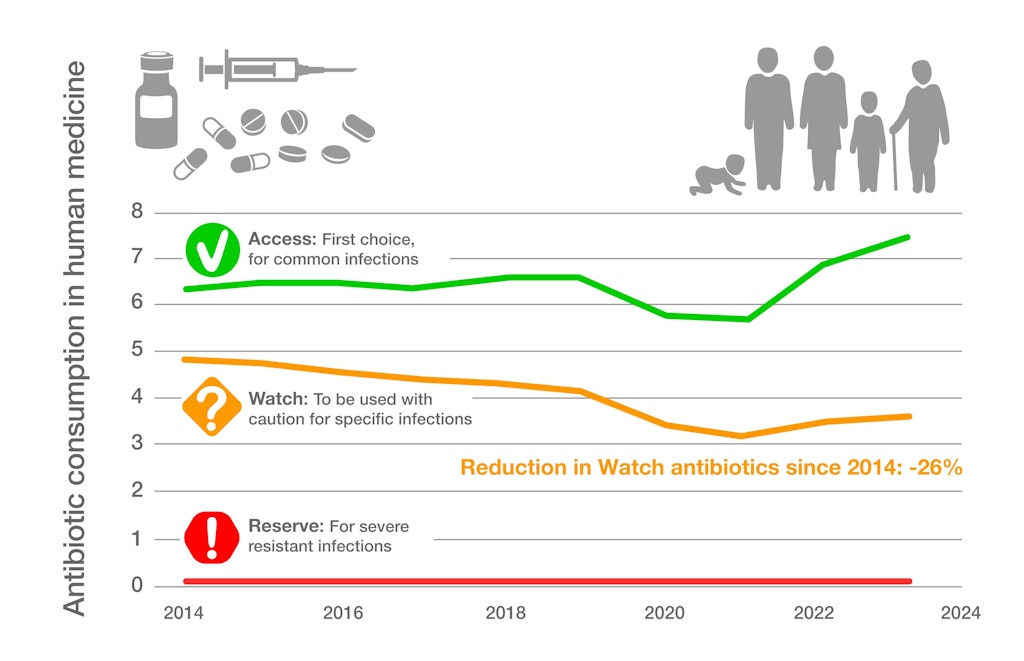
In terms of critical antibiotics from the Watch group, there has been a 26% decline since 2014. The proportion of the less critical Access antibiotics, which should be prescribed as the first choice, as a share of total consumption therefore increased to 66%. Since 2019 Switzerland has exceeded the World Health Organization’s target for Access antibiotics of 60%. The Action Plan aims to further improve the proportion to 69%.
In Switzerland 87% of antibiotics are used in medical practices and 13% in hospitals
There are marked regional differences in consumption across Switzerland: in German-speaking parts of the country, consumption per inhabitant (at 7.8 DDD) is lower than in the French-speaking and Italian-speaking parts (at 13.1 DDD and 12.4 DDD, respectively). The Action Plan seeks to reduce these regional differences. In 2023, general practitioners prescribed most antibiotics to treat diseases of the upper respiratory tract (30%) and urinary tract infections (28%). Around 20% of prescriptions involved classes of antibiotics that are not recommended in the national guidance.
Per-capita consumption of antibiotics in human medicine (in defined daily doses per 1000 inhabitants per day) by AWaRe (Access, Watch and Reserve antibiotics) category.
Antibiotic use continues to decline in veterinary medicine
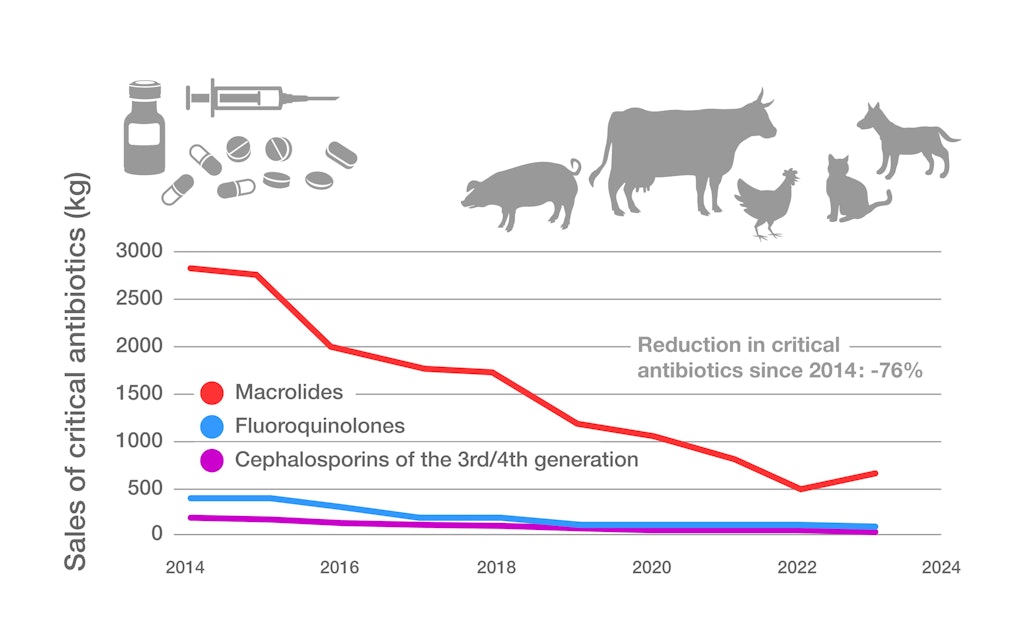
Antibiotics are used to treat bacterial infections. In 2023, a total of 24 tonnes were used in veterinary medicine in Switzerland, the majority of which were administered to livestock and only around 3% to domestic animals. The total volume of antibiotics sold to veterinarians in 2023 decreased by 14% compared with 2021 and by 48% compared with 2014. In particular, the downward trend continued in so-called critical antibiotics where potential resistance is especially problematic and which should only be used to treat certain infections. Since 2014, the volume of critical antibiotics sold to veterinarians for livestock has declined by 76%, and a significant decrease has also been recorded for domestic animals. By European comparison, Switzerland is already among the countries with relatively low antibiotic use. The goal is to be one of the five best-performing countries in Europe in terms of the sale of critical antibiotics by 2027.
Since 2019, veterinarians have also recorded every single antibiotic prescription in the dedicated information system (IS ABV). Analysis of this data shows that primarily first-line antibiotics are used for all species and that veterinarians in Switzerland are therefore following the treatment guidelines effectively. In livestock, cattle are the most likely to be treated with antibiotics (564 treatments per 1,000 animals), followed by poultry, small ruminants (sheep and goats) and pigs (fewer than 80 treatments per 1,000 animals).
Sales of critically important antibiotics for veterinary medicine (livestock and domestic animals) in kilograms.
Antibiotic pollution in rivers, lakes and groundwater can be reduced by retro-fitting sewage treatment plants
After antibiotics have been ingested by humans and animals, they are partially excreted and can thus end up in wastewater, waterbodies and soil. Antibiotic concentrations decrease from wastewater to river water due to dilution effects. From river water to ground water, the concentrations decrease further as antibiotics are partly degraded or retained during bank filtration or when they pass through the soil.
Conventional sewage treatment plants can only partially remove antibiotics. However, additional treatment steps to eliminate micropollutants can reduce the measured concentrations of antibiotics by a factor of ten. In 2024, around 15% of Swiss wastewater was purified in such treatment steps, and by 2040 that figure is set to be 70%. Measurements conducted in Furtbach (AG/ZH) show that by retrofitting a sewage plant, the concentration of antibiotics is reduced so much that the Environmental Quality Standards are no longer exceeded. Based on current evidence, it is unlikely that the antibiotic concentrations measured in Swiss waterbodies are directly promoting the development of resistance.
Development of the resistance situation
Many microorganisms are naturally present in the environment and on the skin, in the mucosa or in the intestine of humans and animals (e.g for digestion). However, if these bacteria enter the body and multiply excessively, this is referred to as an infection. This happens, for example, if the skin or mucosa are damaged, or in people with immunodeficiency. If the bacteria that cause the infection are resistant to certain antibiotics, it becomes difficult, or even impossible, to treat the infection.
Data on resistance rates in humans and animals has been collected in Switzerland for around 20 years. It is always done for a specific bacterium and class of antibiotic. The most important pathogens and antibiotics show a mixed picture: while antibiotic resistance has significantly increased in some bacteria, it has remained stable or decreased in others. Overall, resistance rates have stabilised in recent years.
Resistance rates have stabilised in human medicine
Based on resistance data, modelling can be used to estimate the disease burden and number of deaths caused by antibiotic resistance. For Switzerland it is estimated that the disease burden is around 85 infections per 100,000 inhabitants and that around 300 people a year die from infections caused by resistant pathogens. Relative to the size of its population, Switzerland is less affected by infections caused by resistant bacteria than France or Italy, but more so than the Netherlands or Scandinavian countries.
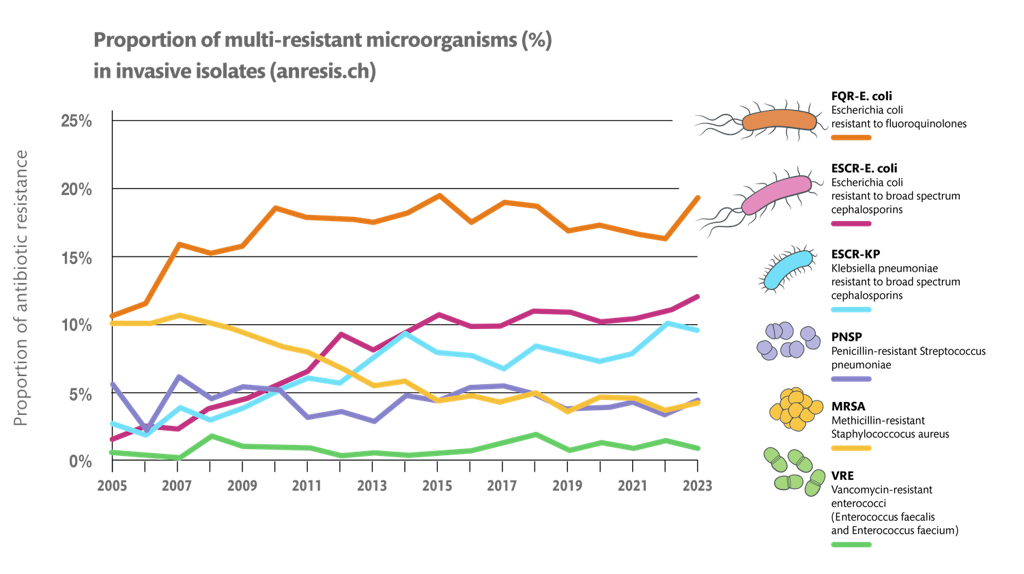
On the whole, resistance rates have stabilised in human medicine. The rate of invasive infections (e.g. sepsis) caused by resistant bacteria has significantly decreased in the last 15 years for some pathogens, particularly methicillin-resistant Staphylococcus aureus (MRSA), for which resistance rates have halved. The resistance rates against fluoroquinolones and third-/fourth-generation cephalosporins in E. coli and Klebsiella pneumoniae, which rose considerably between 2004 and 2015, have fortunately stabilised in the last five years. The resistance of these bacteria to carbapenems (carbapenemase-producing Enterobacterales (CPE)) pose a particular threat to public health, which is why they have been subject to mandatory notification since 2016. The number of reported cases has risen steadily since, although consumption is low compared with neighbouring countries.
Resistance among major pathogens in human medicine: percentages of bacteria resistant to specific antibiotics in invasive infections.
The monitoring of resistance rates in animals is carried out via two different surveillance systems. To assess the potential risk to humans, commensal indicator bacteria and zoonotic bacteria are monitored from healthy slaughter animals and meat. Commensal indicator bacteria do not normally cause diseases themselves, but can pass on resistance to other bacteria, including to those that can cause diseases in humans. The monitoring of indicator bacteria, in particular E. coli in slaughter animals and meat, therefore gives a good overview of the development of resistance. Zoonotic bacteria can be transmitted from animals or food to humans. The diseases they cause are called zoonotic diseases or zoonoses.
Resistance has also been monitored since 2019 in pathogenic bacteria for livestock and domestic animals. This data can help guide the choice of antibiotics used to treat infections.
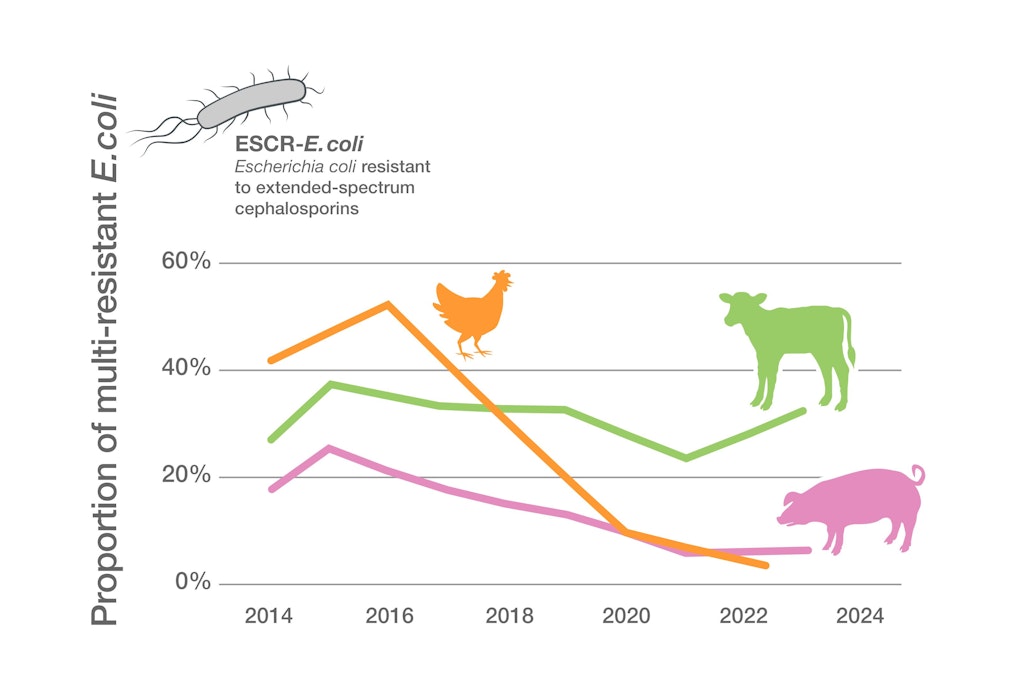
Antibiotic resistance has evolved differently in slaughter animals, meat, live-stock and domestic animals
The spectrum of potentially pathogenic bacteria in livestock and domestic animals is very broad. The resistance situation therefore also varies widely depending on the type of bacteria and species concerned.
Resistance rates in the veterinary field: proportions of extended-spectrum cephalosporin-resistant E. coli (resistant to third- and fourth-generation cephalosporins) found in the appendixes of slaughtered animals (broiler chickens, veal calves and fattening pigs).
The Swiss Antibiotic Resistance Report (SARR) is the national report on the antibiotic resistance situation in Switzerland. The report not only focuses on antibiotic consumption and resistance in human and veterinary medicine, but also on the impacts in the environment (One Health approach).