
StAR in the environmental sector
In order to preserve effective antibiotics, a holistic approach based on the One Health principle – as envisaged by StAR – is necessary for humans, animals and the environment. For example, the expansion of wastewater treatment plants with a fourth treatment stage is intended to massively reduce the entry of antibiotics and other micropollutants into water bodies.
In focus
StAR One Health Action Plan 2024 – 2027: Strengthening wastewater management measures (D, F, I)
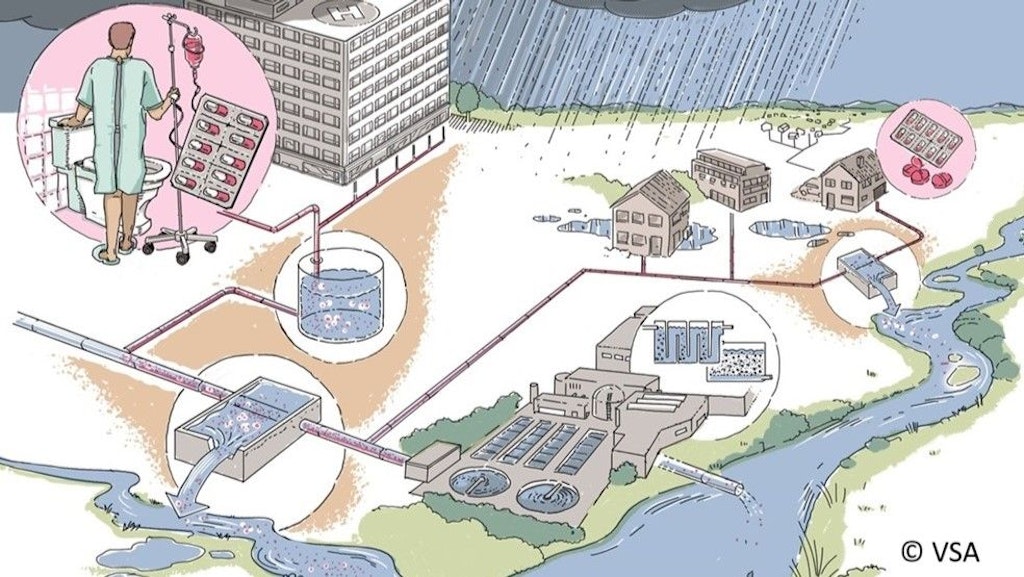
Antimicrobial resistance is one of the greatest global health threats and should be prevented from entering the environment wherever possible. Wastewater treatment plants are becoming increasingly effective at retaining antimicrobial resistance and antibiotics as standards continue to improve. However, combined sewer overflows remain a dominant source of contamination in waterways. The present analysis shows that, on the one hand, enhanced measures in wastewater management in healthcare facilities and, on the other hand, optimisations in sewer network management will further reduce inputs into water bodies.
Wastewater management
Wastewater treatment is a success story. Thanks to the virtually nationwide expansion of wastewater treatment plants, water quality in Switzerland has improved significantly in recent decades. The next step is to remove micropollutants. Fees based on the polluter pays principle are a prerequisite for ensuring that wastewater treatment continues to function in the future.
Wastewater treatment plants are becoming increasingly effective at retaining antimicrobial resistance and antibiotics as standards of construction improve. However, combined sewer overflows represent a dominant source of pollution in waterways. This analysis shows that, on the one hand, enhanced wastewater management measures in healthcare facilities and, on the other hand, optimisations in sewer network management will further reduce pollution in waterways. The Swiss Association of Wastewater and Water Protection Specialists (VSA) is tackling these important tasks in close cooperation with the relevant stakeholders.
Aktionsplan Strategie Antibiotikaresistenzen 2024-2027: Massnahmen beim Abwassermanagement verstärken (In German, French and Italian)
Surveillance
The distribution and use of antibiotics, as well as the emergence and development of resistance, are monitored across all areas. This data forms the basis for targeted interventions and performance reviews. Information on the development of antibiotic consumption and resistance can be found here.
As part of the National Groundwater Monitoring Programme NAQUA, the FOEN records the status and development of groundwater resources at more than 600 measuring stations in Switzerland. It monitors the natural status and the impact of human activities on aquifers typical of Switzerland.
In order to assess the condition and development of water bodies throughout Switzerland, data must be collected and documented on a regular basis. The FOEN, in collaboration with the cantons, provides this basis with the National Surface Water Quality Monitoring Programme (NAWA). Through the NAWA FRACHT sub-programme (National Long-Term Investigation of Substance Loads in Swiss Watercourses), the federal government, in collaboration with the two federal research institutes Eawag and WSL, collects data on substance loads in larger rivers.
Priorities, objectives and measures of StAR in the environmental sector
Information on the priorities, objectives and measures of StAR