
StAR in the human health sector
Antibiotics are life-saving medicines used to treat bacterial infections. However, they are becoming increasingly ineffective due to resistance. For this reason, the Strategy on Antibiotic Resistance Switzerland (StAR) has been in place since 2015. Measures relating to humans are coordinated by the Federal Office of Public Health and implemented in collaboration with the cantons and numerous other stakeholders. Various guidelines and tools are available to help patients, doctors and pharmacists fulfil their responsibilities when using antibiotics.
Please note that not all content is available in English. To view all content, please visit the German, French or Italian version of our website.
In focus
Prescribing guidelines and resistance information
National prescribing guidelines
The Swiss Society for Infectious Diseases (SSI) regularly develops and publishes guidelines that enable doctors to optimise the use of antibiotics in line with the latest scientific findings. The guidelines are regularly updated and adapted to development of the resistance situation in Switzerland. They are available at ssi.guidelines.ch. Users can submit suggestions or ask questions via a comment function, thereby helping to further improve the guidelines.
Current resistance data on ANRESIS
The ANRESIS Guide app from the Swiss Centre for Antibiotic Resistance provides a clear and intuitive overview of the latest resistance data. This supports the use of antibiotics tailored to the local resistance situation. The SSI guidelines are also linked. You can find general information and the latest trends at anresis.ch.
Guidelines for hospitals and nursing homes
Guidelines for hospitals and nursing homes
An Antimicrobial Stewardship Programme (ASP) is a coherent set of measures designed to promote the responsible use of antimicrobial agents. Swissnoso launched the Swiss ASP in 2016 on behalf of the FOPH. Within this framework, a ‘Handbook for the implementation of ASP in acute care hospitals in Switzerland’ was developed based on international standards and the needs in Switzerland. A second edition is planned for 2026 and will include a wide range of implementation aids. The handbook contains recommendations for hospitals on structural adjustments (e.g. setting up ASP teams) and the gradual introduction of specific interventions (e.g. audits, feedback or restrictive measures to limit the use of reserve antibiotics). In addition, hospitals have access to ANRESIS' interactive stewardship dashboards.
Prevention and control of multi-resistant pathogens
Multidrug-resistant pathogens (MRE) pose a major challenge for hospitals and, in some cases, a critical threat to the patients affected. In order to curb the spread of antibiotic-resistant pathogens in hospitals, the Swiss National Centre for Infection Prevention (Swissnoso) has developed national recommendations for the prevention and control of outbreaks of MRE as part of StAR. These include pathogen-specific guidelines for containing the transmission of MRPs, such as systematic screening and isolation measures, as well as specific measures and steps to be taken in the event of an outbreak. MRP guidelines are part of the structural minimum requirements for the prevention and control of healthcare-associated infections (HAIs) in Swiss acute care hospitals. Further measures for monitoring, preventing and controlling HAIs are being implemented as part of the NOSO strategy.
Guide to infections in nursing homes
Studies show that infections are relatively common among elderly people in nursing homes. Diagnosing infections in a medical-social setting is not always easy. This leads to antibiotics being prescribed in cases of doubt, even when this may not be necessary. HPCi Vaud has therefore worked with its partners to develop a practical guide for the prevention, diagnosis and treatment of common infections in nursing homes. The guide is available in French, German and Italian: Guide des infections en EMS | Hygiène, prévention et contrôle de l'infection.
Information and education
Communication Materials
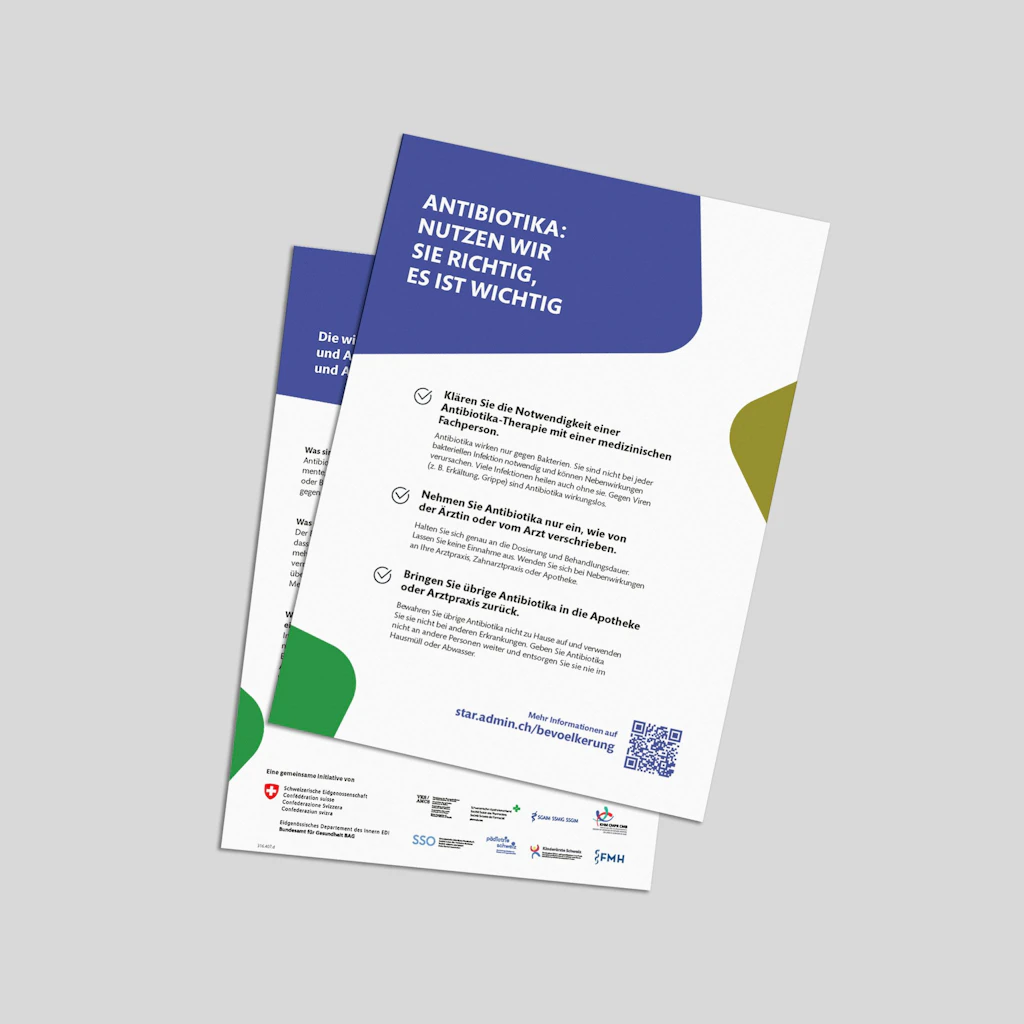
General information for the public at star.admin.ch
Background information is provided to patients at star.admin.ch. The most important information can be found on the website intended for the general public.
Decision-making aids for prescribing antibiotics in practice and quality circles
The Bern Institute for Family Medicine (BIHAM) has compiled evidence-based medical information and decision-making aids to support family doctors and their patients in participatory decision-making regarding the prescription of antibiotics. Easy-to-understand graphics show the advantages and disadvantages of treatment with and without antibiotics for tonsillopharyngitis, otitis media, urinary tract infections, acute infectious cough and rhinosinusitis. The aids are also ideal as food for thought and training aids in quality circles. A facilitation guide is also available for this purpose.
Surveillance
The distribution and use of antibiotics, as well as the emergence and development of resistance, are monitored across all areas. This data forms the basis for targeted interventions and performance reviews. Information on the development of antibiotic consumption and resistance can be found here.
ANRESIS
As part of the StAR programme, the FOPH has commissioned the Swiss Centre for Antibiotic Resistance ANRESIS to expand the monitoring of resistance and consumption. An important goal of ANRESIS is not only to collect data, but also to analyse and process it in such a way that it can be made available to doctors, hospitals, researchers, policy makers and the general public.
National reference laboratory
With the support of the FOPH, the National Reference Laboratory for the Early Detection and Monitoring of Antibiotic Resistance (NARA) was established in 2017. NARA is located at the University of Fribourg and is operated in a consortium with the University Hospital of Vaud (CHUV) and the University of Zurich. Its main tasks are to identify known or novel resistance mechanisms and to warn stakeholders of clinically relevant risks. NARA also assists clinical laboratories in their surveillance tasks by developing diagnostic tests and supporting nationwide epidemiological studies.
Priorities, objectives and measures of StAR in the human health sector
Information on the priorities, objectives and measures of StAR
Strategy on antibiotic resistance in the human health sector